Scientists Discovered the Brainwave Behind Empathy. Reconnecting Gamma Might Resurrect Human Compassion

Two very different groups of researchers have spent the last decade studying the same three pounds of tissue for opposite reasons. One wanted to understand what allows a person to put someone else’s interest ahead of their own. The other wanted to know exactly how long they could hold a person’s attention, whatever that required. New research out of the University of Zurich just handed the first group something concrete: a specific brainwave rhythm that appears to switch caring on, measurable and, within limits, adjustable.
Researchers Jie Hu, Marius Moisa, and Christian Ruff found that altruistic choices depend not on local activity in a single brain region but on functional integration between areas involved in self-related and other-related processing, according to their study published in PLOS Biology. Using transcranial alternating current stimulation, the team enhanced gamma-band synchrony, in the 30 to 100 Hz range, between the frontal and parietal lobes, and watched participants become measurably more likely to share money with a partner even at a cost to themselves. Alpha-band stimulation produced no such effect. Only gamma did.

Teen friends portrait sitting together
Caring Is a Coordination Problem, Not Just a Character Trait
The finding reframes something we tend to treat as fixed. We usually picture altruism as an honorable character, some people as generous, others not, shaped by upbringing or moral conviction. But the study suggests altruistic decisions are more dynamic, depending on how different brain regions coordinate in the moment of choice. The effect was strongest specifically when participants stood to lose something by being generous, the exact moment self-interest usually wins. That’s when the frontal region representing another person’s interest most needs to reach the parietal region guiding the decision, and gamma synchrony appears to be the channel the gamma connection operates within.
Senior researcher Christian Ruff was careful about the limits of the findings. The team didn’t record brain activity directly during stimulation, so they can’t draw a strict cause-and-effect; they did identify a real pattern of inter-regional communication tied to altruistic choice, and the finding sets the stage for further research on cooperation. It’s early, single-study evidence in a lab game, not a settled account of human generosity. But it hands us a concrete, physical answer to a question that used to live entirely in philosophy: caring for someone else appears to require the brain to integrate two kinds of information, and gamma symmetry was doing a good portion of that workload.
Random Causality? Or By Design?
That finding stands in contrast to what’s actually documented about how the platforms most young people spend their days inside were engineered. This part isn’t speculation. Facebook’s founding president, Sean Parker, has publicly described the founding question behind features like the Like button as a search for how to consume as much of a user’s time and conscious attention as possible, engineering a small dopamine hit with every notification to keep people posting and returning. Justin Rosenstein, who helped build that same feature, later called it a manufactured dose of pseudo-pleasure, describing the broader system as exploiting a real vulnerability in human psychology.
Frances Haugen’s 2021 testimony and the internal documents she brought with her added details nobody outside the company had access to before. Meta’s own research showed awareness that Instagram was worsening body image problems for a meaningful share of teenage girls who used it. A 2018 internal shift toward optimizing for what the company called meaningful engagement ended up making the platform more divisive rather than less, according to Haugen’s account, because conflict and outrage reliably hold attention longer than agreement does. None of this required inventing a hidden goal of making anyone less empathic. The documented goal was simpler and, in a way, more damning: hold attention, whatever that required, and address the downstream harm later if at all.
That engineering didn’t happen in a vacuum staffed only by engineers. The broader industry Haugen worked inside drew directly on behavioral psychology and neuroscience, most visibly through Stanford’s Persuasive Technology Lab, whose founder, B.J. Fogg, trained a generation of Silicon Valley product designers in exactly the mechanics of variable reward and habit formation that later showed up in feed design across the industry. A company called Dopamine Labs marketed its consulting services with the explicit pitch that keeping users engaged wasn’t luck but science, delivering the right neurochemical response at the right moment to keep an app in someone’s hand longer. None of that required a secret memo naming empathy as the target to erode. Attention was the target. Empathy, on this account, was never the objective. It was the thing sitting in the way of the objective, and it lost.

A Trait That Actually Moved, on Paper
Whether that engineered environment shows up as measurable personality change is a separate question; the research existed before most of today’s platforms did. Sara Konrath’s 2011 meta-analysis, combining 72 studies of American college students between 1979 and 2009, found empathic concern and perspective-taking declining sharply and consistently across three decades, with the steepest drop occurring after 2000. Konrath’s team measured today’s college students as roughly 40 percent lower in empathy than their counterparts of 20 to 30 years earlier, alongside a parallel, well-documented rise in narcissism over the same period.
The honest caveat matters here. Konrath’s data ends in 2009, before Instagram had scaled and years before TikTok existed, so it can’t tell us anything directly about the specific engagement architecture Haugen later exposed. The design she described came after the trend Konrath measured, not before it. What the meta-analysis does establish is that something in the broader shift toward digitally mediated, self-presentational social life was already correlating with less empathy and more self-focus, well before the most sophisticated engagement engineering arrived. If anything, that makes the later platforms a plausible accelerant of an existing trend rather than its sole cause, and I’d rather state it that way than overreach the data.
The Empathy Circuit Going Dark
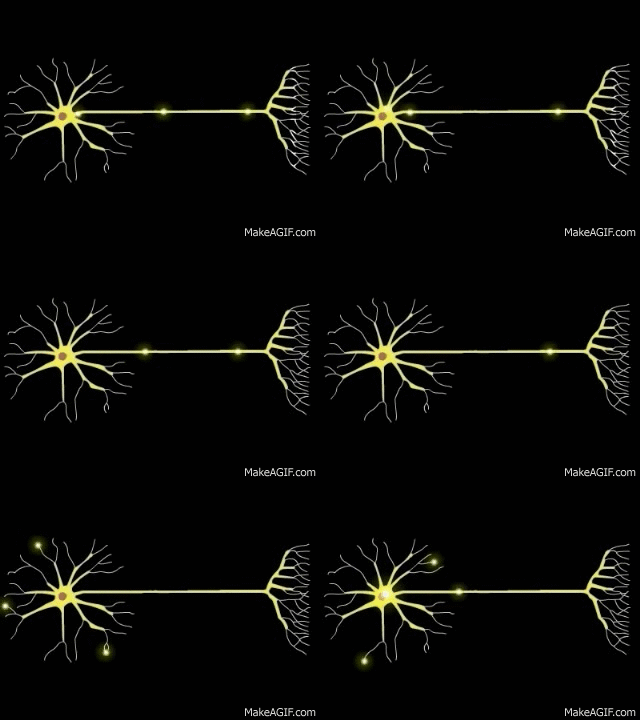
A psychiatry resident named Brandon Batarse recently laid out in Psychiatric Times exactly what that erosion looks like within a single patient. His case was a middle-aged security guard with PTSD whose feed drifted, through ordinary algorithmic recommendation rather than anything he searched for, from music and guitar lessons toward police body-cam footage and street fights. Across visits, his affect flattened and his language about the people in those videos grew harsher and more dismissive. Batarse’s account of the underlying neurobiology gives that drift a mechanism. Repeated exposure to violent content is associated with a less reactive amygdala and reduced engagement in the prefrontal regions that process emotion, the signature of desensitization. Separately, that same repeated exposure has been shown to reduce functional connectivity within the default mode network, the system responsible for mentalizing, understanding what another person is likely thinking or feeling. When that network goes quiet during compulsive scrolling, a person can still know intellectually that something is wrong while no longer feeling that it’s wrong, because the circuitry that would generate the feeling has gone dark.
That’s a genuinely different brain system from the frontoparietal gamma synchrony in the Zurich altruism study, and I don’t want to blur the two into one mechanism they aren’t. But they point to a shared theme from two separate directions. One line of research shows that other-regarding behavior depends on active, effortful coordination between brain regions handling self-interest and another person’s interest. The other shows that heavy exposure to algorithmically escalated violent content suppresses the very network responsible for modeling what another person is experiencing in the first place. Whether the coordination fails to form or the modeling capacity gets quietly switched off, the end state looks similar from the outside: someone who no longer bridges the gap between their own experience and someone else’s.
What the Numbers on Youth Actually Show
The data moves from suggestive to specific once you look at the affect numbers on youth directly. A 2024 Youth Endowment Fund survey of more than 10,000 British teenagers found that 70 percent had encountered real-world violence on social media, and a quarter of those said the exposure was algorithmically promoted rather than something they went looking for. Among teens who had themselves perpetrated violence, 64 percent said social media played a role in their behavior. A separate study found 43 percent of young Instagram users had encountered self-harm content without searching for it, and more than half of those exposed reported lasting emotional distress afterward.
Layer that against the criminology data. Total juvenile crime in the United States has declined substantially since its early-1990s peak, and that broader decline continued through much of the past decade. But juvenile homicide rose 65 percent between 2016 and 2022 even as burglary, larceny, and robbery by youth fell sharply over the same stretch, and offending among the youngest cohort, ages 10 to 14, rose 9 percent while offending among older teens declined 23 percent. It isn’t a story of steadily rising, random violence among young people as a whole. It’s a narrower and more specific pattern: a subset of incidents growing more severe, now sitting alongside direct self-reported evidence, not just theory, that algorithmically delivered content is part of what’s shaping how some of these young people process and respond to conflict in the first place.
I’ll still offer my own clinical read of that convergence as a hypothesis, not a settled finding. If a young person’s mentalizing network is getting less practice through years of passive, algorithm-driven exposure, and if other-regarding decisions require active coordination the way the Zurich study suggests, then a nervous system with less of both may have less available to it in the moment a conflict escalates, less capacity to model the other person’s experience, less of the coordinated signal that normally pulls someone back from crossing a line. That’s my theory to hold loosely. The Youth Endowment Fund and Instagram exposure data are not.
Where This Points, Clinically
I find genuine hope in this next part rather than grimness. If gamma-band synchrony between frontal and parietal regions is doing real work in supporting other-regarding behavior, and if a nervous system can be trained to move toward a target rhythm through feedback the way alpha and theta rhythms already can, the same logic that underlies our alpha-theta protocol for anxiety and insomnia may eventually extend into training gamma coordination directly. That’s forward-looking, not something we’re claiming to deliver as a finished protocol. The Zurich study used external electrical stimulation in a single 44-person lab experiment, not neurofeedback, and nobody has yet built or validated a gamma-training protocol for empathy or prosocial behavior in a clinical population.
Coherence, in this context, is a specific measure: how well the timing of activity in one region lines up with activity in another, the same kind of relationship the Zurich researchers were manipulating directly with stimulation. Seeing where that coherence fires low value in a given client’s map is already informative even before any dedicated gamma protocol exists to train it, because it tells us much about which circuits may need support that alpha-theta training alone doesn’t reach.
Looking Towards the Future
As this research matures, gamma coordination is a genuinely promising place to look next, not because we’ve solved it, but because for the first time there’s a specific, physical, trainable-in-principle mechanism connecting a rhythm we can already measure to the exact quality, caring enough to act on someone else’s behalf, that a culture saturated in engagement design has been quietly wearing down. A nervous system that lost practice at this task of coordination through years of self-referential feedback loops is not a nervous system that’s broken beyond repair. It may simply need a new kind of practice, and for once, the neuroscience is starting to describe what that practice might actually look like. If a nervous system can be pulled toward hypervigilance by years of engineered feedback loops, there’s no reason to assume it can’t also be pulled back the other way, toward the coordination that lets us actually show up for each other again.