War News Anxiety: Understanding Secondary Trauma and the Downward Economic Cascade
We’re watching war coverage at levels nobody’s seen before. You start just wanting to stay informed. Then it becomes something else entirely.
A pattern develops. Moderate to severe anxiety that won’t quit. Researchers call it secondary trauma, and it’s real. Not just a few people are experiencing distress. Entire populations are absorbing traumatic content through 24-hour news cycles, and the fallout extends way beyond individual anxiety. Economic consequences. Social consequences. Communities reshape themselves around collective fear.
The Psychology of Secondhand Trauma
Here’s what happens: secondary traumatic stress develops when people experience trauma-related symptoms just from exposure to other people’s traumatic experiences.
Researchers at the University of Belgrade found something startling. Secondary traumatization mimics post-traumatic stress disorder almost perfectly. Intrusive memories. Negative alterations in how you think and feel—changes in how your nervous system responds to threats. You don’t need direct exposure to a traumatic event for symptoms to develop.
War coverage creates a transfer pathway. Images of destruction play on loop. Interviews with survivors—detailed descriptions of violence. The trauma moves through the media and lands in your nervous system.
Maša Vukčević Marković and Marko Živanović documented this in people working with trauma survivors. Their 2022 study in the International Journal of Environmental Research and Public Health showed that workers developed symptoms nearly identical to those of the people they were helping. And the study revealed something counterintuitive about coping strategies.
Avoidant responses predict worse outcomes. Passive responses predict worse outcomes. People who try pushing disturbing images out of their minds? Those same images come back as intrusive thoughts, disturbing dreams, and pronounced physical reactions when they encounter reminders.
The Economic Cascade
When war breaks out, something shifts in the collective psychology. Consumer spending drops. Fast.
People prioritize security over discretionary buying. Economists have recognized this pattern for decades, but the mechanism involves more than rational risk assessment. Fear spreads like wildfire and herd mentality takes over.
Your neighbor postpones buying a new car. Your coworker mentions economic uncertainty at lunch. Pretty soon, everyone’s pulling back, and the collective behavior accelerates on its own momentum—retail sales decline. Businesses cut hours. Layoffs begin.
The economic contraction that follows isn’t about rational market forces. It reflects an entire population responding to a perceived threat, even when that threat exists thousands of miles away.
Then comes phase two. Job losses and business closures, large and small, generate a second wave of anxiety. People who initially worried about distant conflicts now face immediate threats to their financial security. Income disappears. Health insurance ends. The stress of daily survival eclipses concerns about international events.
Anxiety levels don’t just increase. They double or triple as the crisis shifts from abstract to personal.
Clinical Definition: Secondary Trauma
Mental health professionals have a specific term for this pattern—secondary trauma.
Primary trauma means you directly experienced a threatening event. Secondary trauma develops from witnessing or hearing about others’ suffering. But don’t mistake “secondary” for “minor.” The condition is characterized by real symptoms: hypervigilance, difficulty concentrating, irritability, sleep disturbances, and persistent worry about future threats.
The University of Belgrade research identified symptom clusters that mirror PTSD. Negative alterations in cognition, mood, and reactivity appear first. People report feeling detached from normal activities. Can’t find pleasure in things they used to enjoy. Struggle with persistent negative emotions that won’t lift.
Then intrusions start. Unwanted memories of disturbing news images. Nightmares featuring war scenarios—sudden emotional reactions when you encounter related content.
Avoidant behaviors emerge as people try to protect themselves from ongoing distress. Some stop watching the news entirely. Others change the conversation topics when war comes up. Many develop elaborate strategies to dodge reminders.
And here’s the kicker: the research found that avoidant coping mechanisms actually predict more severe symptoms over time. Trying to outrun the anxiety amplifies it.
Secondary trauma wrecks sleep through multiple pathways.
Hyperarousal makes falling asleep nearly impossible. Your prefrontal cortex stays active, generating beta-frequency EEG activity (15–35 Hz) that prevents your brain from downshifting into the slower alpha and theta rhythms you need for sleep onset.
People experiencing secondary trauma lie awake replaying disturbing images and planning worst-case scenarios. Or just feeling unable to relax despite exhaustion. Even when sleep finally comes, it stays fragmented and unsatisfying.
The intrusive thoughts don’t stop at the threshold of consciousness. They emerge as vivid, disturbing dreams that jolt you awake. Sleep fragments further. The cycle reinforces itself.
Poor sleep weakens emotional regulation. Anxiety gets worse. Heightened anxiety generates more sleep disruption. Without intervention, the pattern becomes self-sustaining. Chronic insomnia develops and persists even after triggering events fade from headlines.
Brainwave Patterns in Secondary Trauma
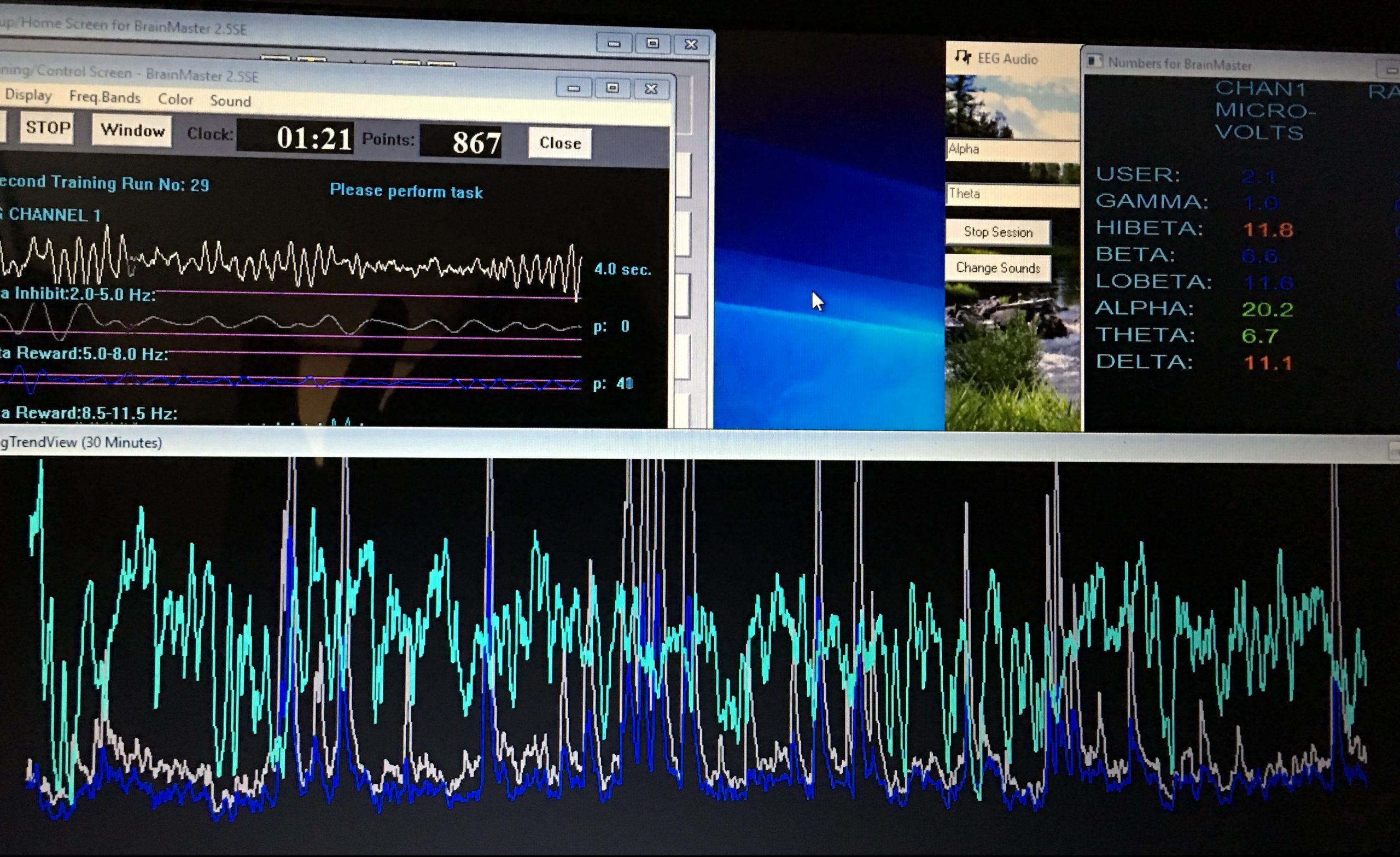
Neurofeedback research reveals measurable changes in brainwave activity among people experiencing secondary trauma.
Those elevated beta frequencies that prevent sleep onset? They reflect chronic hyperarousal in your brain’s threat-detection systems. Instead of cycling through normal patterns of activity and rest, your prefrontal cortex stays in a constant state of high alert.
Alpha-theta training addresses this by helping your brain relearn dormant relaxation patterns. When beta activity dominates, your nervous system interprets everything as a potential threat. A news notification triggers the same physiological response as actual danger. Your amygdala activates. Stress hormones are released. Your body prepares for action even when there is no immediate threat requiring a response.
Breaking the pattern requires retraining your brain’s baseline activity. As alpha frequencies (8–12 Hz) increase and beta frequencies normalize, your nervous system recalibrates its threat assessment. Environmental cues that previously triggered anxiety responses begin registering as neutral information.
Sleep becomes accessible again. Your brain releases its defensive posture.
Why Some People Develop Secondary Trauma, and Others Don’t
A University of Belgrade study identified specific coping mechanisms that predict who will develop severe symptoms.
Problem-focused coping correlated with lower symptom severity. People who respond to disturbing news by researching organizations accepting donations, identifying concrete ways to help, or creating personal action steps experience less psychological distress than passive observers.
Passive coping strategies were associated with the worst outcomes. Acceptance without action. Using humor to deflect discomfort and simply restraining response. All left people vulnerable to escalating symptoms. The research found that passive coping mechanisms accounted for more variance in secondary trauma symptoms than even avoidant coping.
Moving Beyond Symptom Management
Most clinical approaches to secondary trauma focus on managing symptoms after they develop.
Cognitive behavioral therapy helps people identify and challenge anxious thoughts. Medication temporarly reduces anxiety and improves sleep. But these approaches address symptoms rather than causes.
Neurofeedback offers a different pathway. Target the root neurological dysregulation. When your brain learns to reduce excessive beta activity and restore balanced brainwave patterns, symptoms resolve naturally.
Sleep improves because your brain regains its ability to downshift into sleep-conducive states. Anxiety decreases because your nervous system stops interpreting neutral stimuli as threats. Intrusive thoughts fade as your amygdala stops flagging routine experiences as danger signals.
The process requires consistency. Alpha-theta neurofeedback sessions every other day over several weeks give your brain time to consolidate new patterns. Most people target 30-minute sessions, target a goal of 6.5–8.5 hours of sleep along with significant anxiety reduction. Unlike medication that must be taken indefinitely, neurofeedback creates lasting changes in brain function.
The Broader Picture
Understanding secondary trauma matters beyond individual treatment.
When substantial portions of the population experience trauma-related symptoms from news consumption, the collective impact shapes economic behavior, social cohesion, and public health. Recognizing the pattern allows for tangable relief before the cascade accelerates.
Communities benefit from collective approaches. Limit exposure to graphic content. Create support groups for processing distress. Emphasize solution-focused coping strategies. When fear becomes the default response to international events, rational assessment of actual risk becomes impossible.
The research is detailed on three points: passive observation of others’ trauma creates measurable psychological harm. Avoidance amplifies that harm. And brain changes generated by chronic exposure to disturbing content don’t resolve just because headlines shift. Hyperarousal persists. Sleep disruption persists. Anxious reactivity persists until the underlying neurological patterns receive direct intervention.
For many Americans, war news has become a source of personal distress that mimics direct trauma exposure—recognizing secondary trauma as a legitimate clinical concern rather than dismissing it as excessive sensitivity opens pathways for effective treatment.
The brain’s capacity for relearning balanced patterns offers real hope that the anxiety cascade can be reversed.
For more info on Sleep Recovery’s programs, please visit: https://sleeprecovery.net or call 800 927 2339