Your Brain on Empty: Why Sleep Deprivation Destroys Attention (And How You’re Trapped)
Skip one night of sleep, and your brain becomes something fundamentally different. Not tired. Different.
Researchers at Duke-NUS Medical School discovered something disturbing when they put sleep-deprived people through fMRI scanners during attention tasks. The brain doesn’t just slow down uniformly. Specific regions collapse while others desperately compensate, creating instability that explains why drowsy drivers seem fine one moment, then veer off the road the next.
The 2008 study in the Journal of Neuroscience revealed a critical insight. Attention lapses during sleep deprivation aren’t slower versions of what happens to rested people. They’re qualitatively different neurological events involving dramatic reductions in the visual cortex, compromised frontoparietal control networks, and erratic thalamic responses that swing between overactivation and collapse.
Here’s where neuroscience meets brutal reality. We’ve built a society that systematically prevents the sleep these brain systems need. Social media algorithms engineer compulsion loops designed to capture attention during evening hours. Economic pressures force millions into shift work or multiple jobs, making consistent sleep impossible. Legacy media feeds constant anxiety-inducing content that keeps cortisol elevated and minds racing at bedtime.
Institutionalized sleep deprivation operates at the population scale. Millions of brains function in the same degraded state that researchers documented in labs.
The catch-22 is staggering. Sleep deprivation disrupts the attentional control needed to resist mechanisms that prevent sleep. Your depleted prefrontal cortex can’t muster the executive function to close TikTok at midnight. Your exhausted visual system craves the dopamine hit of one more Instagram scroll. Brain regions that should regulate behavior go offline while regions responding to immediate stimuli stay active, keeping you engaged with whatever screen sits in front of you.
Attention Deficits Cut Both Directions
Well-rested brains compensate during attention lapses. When someone experiences a delayed response to stimuli, frontoparietal control regions show increased activation. The brain recognizes the slip and recruits more neural resources. Quality control systems detect errors and temporarily boost power to fix problems.
Sleep deprivation breaks the mechanism. Sleep-deprived brains show significantly less activation in the medial frontal cortex and intraparietal sulcus during lapses compared to equivalent lapses after normal sleep. Both states showed higher peak signals during lapses than average responses, but the increase proved far more pronounced after normal sleep. Control systems that should detect and correct attention failures can’t fully mobilize when running on empty.
The visual cortex shuts down during lapses in sleep deprivation. Extrastriate cortex showed reduced peak signal during slow responses in the sleep-deprived state. Lapses after normal sleep didn’t show any visual suppression.
The perception scrambling matters enormously. Sleep deprivation doesn’t just make control centers sluggish – it actively degrades sensory processing, feeding information to your brain.
Implications extend far beyond laboratory tasks. Sleep-deprived people trying to drive, read important documents, or monitor equipment aren’t just responding slowly; they’re also making mistakes. They’re literally not seeing the same quality of visual information a rested brain processes. The external world exists in the same detail, but the brain loses the capacity to extract that detail and convert it into useful perceptual information.
Thalamic findings add complexity. The thalamus relays sensory information and plays a crucial role in arousal and attention. Researchers found that task-related thalamic activation was higher in sleep-deprived subjects than in rested subjects at mean response times. The brain actively fights to maintain wakefulness during what appear to be normal performance periods.
During lapses? Thalamic activation dropped precipitously in sleep-deprived states while increasing in rested states.
Researchers termed the pattern “wake-state instability.” Sleep-deprived brains toggle between heightened thalamic activation states (fighting to stay awake and perform normally) and sudden collapses into near-sleep states where the thalamus essentially disconnects sensory processing. You experience periods of relative alertness punctuated by terrifying moments when you suddenly realize you haven’t processed the last several seconds of experience.

Institutional Architecture Engineering Sleep Loss
Nothing happens in a vacuum. Sleep deprivation neuroscience intersects with social structures designed to extract attention and labor in ways that make adequate sleep nearly impossible for huge population segments.
Social media platforms employ engineering teams whose explicit job is maximizing “engagement” – keeping you scrolling when you should sleep. Algorithms learn vulnerability patterns. They know you’re more susceptible to outrage content after 10 PM. They know serving one more video in your specific interest area keeps you on the platform another 15 minutes. They know uncertainty about whether the next swipe shows something interesting locks you in variable-ratio reinforcement, the most addictive reward schedule behavioral psychology knows.
Your sleep-deprived prefrontal cortex, already struggling with executive function, stands no chance against engineered compulsion loops. The same frontoparietal control networks that Chee’s study showed failing during attention lapses are the networks you need to close the app and go to bed. Sleep deprivation degrades the very neural systems required to resist the mechanisms that cause it.
The trap closes.
Economic structures amplify biological vulnerability. Shift work disrupts circadian rhythms in ways that make quality sleep nearly impossible, even when time exists. Multiple part-time jobs with variable schedules prevent consistent sleep-wake timing, which the brain needs to entrain proper sleep architecture. Near-poverty existence generates chronic stress, elevating cortisol and keeping nervous systems incompatible with sleep onset. Financial precarity means lying awake at 3 AM running catastrophic scenarios about rent, medical bills, and job security.
Attention economy and gig economy converge on identical outcomes: populations can’t get adequate sleep, cognitive control systems degrade, vulnerability to platform manipulation increases, while desperation for economic opportunities requiring sleep sacrifice intensifies.
The cycle reinforces itself.
Legacy media contributes to toxicity. Twenty-four-hour news cycles traffic in anxiety because anxiety drives viewership. Your amygdala, already hyperactive from sleep deprivation, gets hammered with content specifically selected to trigger threat responses. Climate catastrophe. Political chaos. Economic instability. Pandemic risks. Each story activates stress systems, antagonizing sleep. You go to bed with a nervous system primed for fight-or-flight, cortisol elevated, wondering why you can’t fall asleep or stay asleep.
Sleep deprivation and attention research reveal why neurological impact matters. After hours of scrolling anxiety-inducing content, you finally fall asleep, already in sleep debt. The next day, the visual cortex processes information poorly; the frontoparietal control systems can’t fully compensate for attention lapses; and the thalamus swings between desperate overactivation and sudden collapse. You stumble through the day neurologically degraded, which makes you more vulnerable to the same evening cycle of algorithm-driven scrolling and stress-induced insomnia.
Breaking the Cycle
Chee’s study findings on intermittent normal brain function during sleep deprivation provide crucial insights for interventions. Even after 24 hours without sleep, subjects showed periods during which frontoparietal activation during fast responses matched that during the rested state. The brain retains capacity for normal function when sleep-deprived. Can’t sustain it consistently.
The problem isn’t irreversible brain damage but instability that resolves with sleep restoration. Visual cortex activation, collapsing during lapses, can recover. Frontoparietal control systems failing to compensate adequately can regain function. Thalamic oscillations between over-activation and shutdown can stabilize into consistent, appropriate arousal levels.
Recovery requires actually getting sleep. Means addressing neurological barriers to sleep (hyperarousal, disrupted sleep architecture, circadian disruption) and social structures that prevent sleep in the first place.
Targeted intervention becomes necessary here. You can’t fix sleep deprivation by trying harder with your sleep-deprived brain. Willpower is a prefrontal cortex function. Your prefrontal cortex is precisely what’s offline. You can’t executive-function your way out of problems caused by executive function failure.
What works? Creating conditions where sleep becomes the path of least resistance rather than something requiring constant cognitive effort. Addressing the neurological state directly through methods that do not rely on degraded control systems to implement themselves.
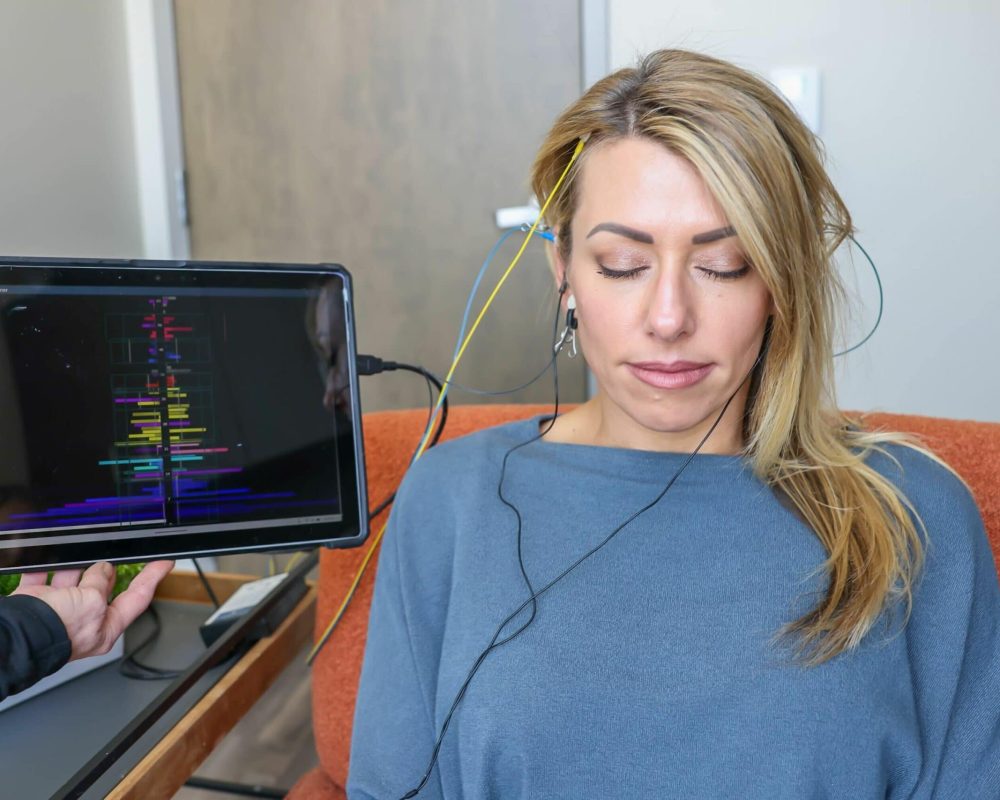
Neurofeedback approaches work with sleep deprivation precisely because they train brain states without requiring executive function or willpower. Alpha-theta protocols shift nervous systems stuck in sympathetic overdrive into parasympathetic activation, which is compatible with sleep. Brainwave entrainment guides destabilized thalamic systems toward oscillatory patterns associated with healthy sleep architecture.
Methods work by bypassing degraded control systems and directly targeting dysregulated arousal states. You’re not trying to think yourself into better sleep or muster the willpower to turn off devices. You’re giving the brain external structure, guiding it toward sleep states when internal regulatory systems have become unreliable.
The importance becomes clear in light of Chee’s study findings on wake-state instability. Sleep-deprived brains oscillate between states because regulatory systems lost stability. Neurofeedback provides external regulation that the brain can entrain to, essentially offering a template for stable function until internal systems recover through actual sleep.
Obviously, larger structural issues remain. Social media will continue to engineer compulsion. Economic systems will keep demanding sleep-sacrificing schedules. The media will keep trafficking in anxiety. But neurofeedback provides neurological intervention points that do not depend on systems already shown to fail under sleep deprivation.
Sleep deprivation isn’t about feeling tired. It fundamentally alters how your brain processes reality. Visual systems extract less information. Control systems can’t compensate for attention failures. Arousal systems swing erratically between over-activation and collapse.
Millions operate with neurologically degraded function, making decisions about work, parenting, health, and safety, with brains demonstrably failing basic attention tasks in labs.
Catastrophic failures make headlines – drowsy driving accidents, medical errors, industrial disasters. Chronic low-level degradation costs more in aggregate: relationship conflicts, poor health decisions, missed opportunities, and inability to function at capacity.
The catch-22 is vicious. The brain systems needed to escape sleep deprivation are the very ones sleep deprivation destroys. But research reveals solutions. Brains retain recovery capacity even in severely sleep-deprived states. Just need interventions that don’t rely on already-failed systems.
We’ve built a society creating institutional sleep deprivation at scale. Understanding the neuroscience of how sleep deprivation destroys attention doesn’t solve larger problems. But it clarifies what’s happening in individual brains caught in the system and why approaches that provide external regulation rather than demand internal control might actually work when everything else fails.
What Sleep Recovery Does Differently
Sleep Recovery, Inc. has worked with thousands of people caught in exactly the trap research describes. Neurofeedback and brainwave entrainment technologies provide an external structure that destabilized brain systems can entrain to.
The approach offers a path to sleep restoration, independent of the executive function that sleep deprivation has already destroyed. Not a complete solution to institutionalized sleep deprivation. But a neurologically sound intervention point for individuals trying to escape the catch-22.
Alpha-theta neurofeedback specifically targets the hyperarousal, keeping people awake. When your nervous system’s stuck in fight-or-flight at 11 PM scrolling doom content, no amount of “trying to relax” works. Your brain’s regulatory systems are offline. External structure provides the shift that your internal systems can’t generate.
Brainwave entrainment addresses the thalamic instability documented by Chee’s study. That oscillation between desperate wakefulness and sudden micro-sleep collapses? Entrainment guides the thalamus toward stable oscillatory patterns supporting consistent arousal and healthy sleep architecture.
Over 4,000 clients across seventeen years. Results occur because the methods work with neurological reality rather than against it. You can’t willpower your way past dysregulated brain systems. But you can provide an external structure for those systems to synchronize with, gradually retraining them toward stability.
The police captain case from our previous article is an extreme example, but the underlying mechanism applies to anyone caught in the attention economy’s sleep deprivation trap. Your brain retains the capacity to recover. Just needs intervention, not requiring the very systems that sleep deprivation has compromised.
Social media engineers will continue to optimize for engagement. Economic systems will continue to demand flexible schedules that disrupt circadian rhythms. News cycles will keep trafficking in anxiety. None of that’s changing soon.
Meanwhile, your brain’s visual cortex is processing information poorly. Your frontoparietal control can’t compensate for lapses in attention—your thalamus swings between states. You’re making life decisions with demonstrably degraded neurological function.
Neurofeedback doesn’t fix capitalism or social media’s business model. But it provides an intervention that addresses the specific brain dysregulation those systems create. For thousands of people, that’s been enough to restore sleep architecture and escape the cycle conventional approaches can’t break.
Research on attention and sleep deprivation should trigger an alarm—instead, brief news coverage, then silence. We’ve normalized what researchers documented as pathological.
Millions operate with degraded visual processing, compromised executive function, unstable arousal. We call it normal modern life rather than a population-scale neurological crisis.
You struggle through days, scroll through nights, wondering why you can’t focus, can’t sleep, can’t break the pattern. Neuroscience explains why willpower doesn’t work. Your prefrontal cortex – willpower’s source – is precisely what sleep deprivation takes offline.
Attention economy exploits vulnerability by design. Platforms optimize for engagement when executive function runs weakest. Algorithms serve arousing content when systems should wind down. Economic structures demand flexibility, destroying the sleep architecture’s required consistency.
You’re fighting engineered systems with degraded neural capacity. The fight’s not fair.
Sleep Recovery recognizes reality. Provides an intervention that doesn’t require you to win fights your brain has already lost. External structure. Brainwave training. Methods bypassing compromised systems.
Seventeen years. Four thousand people. Works because it aligns with neuroscience.
Research documents problems. Solutions require addressing the neurological state directly. Not through willpower, sleep hygiene, or trying harder. Through methods that provide external regulation when internal regulation fails.
Your brain retains recovery capacity. Just needs the right intervention at the right level.
The catch-22 closes when you rely on degraded systems to fix themselves. Opens when you provide the external structure that those systems synchronize with.
Reference: Chee MWL, Tan JC, Zheng H, Parimal S, Weissman DH, Zagorodnov V, Dinges DF. Lapsing during Sleep Deprivation Is Associated with Distributed Changes in Brain Activation. Journal of Neuroscience. 2008 May 21;28(21):5519-5528.