How Fast are Brainwaves? Here’s What Happens When They Start to Slow Down
Most people assume the brain ages the way everything else does — gradually, invisibly, until one day something noticeably stops working. A forgotten name. A word that won’t come. A moment of standing in a room with no idea why.
What if the slowdown had a measurable signature, visible years before any of that happened? And what if there were a way to keep training that signature — the way an athlete keeps training a muscle — long before the decline became a problem?
A landmark multinational study published in the National Science Review suggests that both are true. Researchers introduced a computational model called Xi-αNET, which analyzed resting-state EEG recordings from 1,965 people between the ages of five and one hundred, spanning nine countries. What they found reframes how we understand the aging brain entirely.

The Brain as an Electrical Highway
Every thought, memory, and perception your brain produces depends on electrical signals traveling between regions at extraordinary speed. The insulation that makes that speed possible is myelin — a fatty coating that wraps around nerve fibers, like rubber insulation on an electrical wire. When myelin is thick and healthy, signals travel fast. When it degrades, they don’t.
The Xi-αNET study proved something researchers had long suspected but never mapped so cleanly across a full human lifespan: the frequency of alpha brainwaves, the brain’s primary rhythm of calm, focused awareness, is set directly by myelin quality. Faster conduction from better myelination produces higher-frequency alpha. As myelin thins, conduction slows, and alpha slows with it.
The researchers tracked signal conduction delays across life and found a U-shaped trajectory. Delays are short in childhood, stable through midlife, and then lengthen meaningfully in older age — mirroring independent MRI measurements of myelin integrity with striking precision. In other words, the EEG isn’t just measuring brain activity. It’s measuring the health of the brain’s physical infrastructure.
Lead author Ronaldo Garcia Reyes described the finding: the brain’s electrical rhythms are “reflections of the brain’s physical wiring and the efficiency of its signal highways.”
It’s Not Just Speed — Signal Strength Drops Too
The Xi-αNET findings focus primarily on frequency. But a parallel body of research reveals that amplitude — the sheer strength of brainwave signals — declines with age just as significantly, and the two together paint a fuller picture of what brain aging actually looks like on an EEG.
Studies comparing younger and older adults have found alpha power reductions of up to 20 dB between healthy elderly and younger subjects — not a modest dip, but a dramatic change in the volume at which the brain broadcasts its core rhythms. Research using EEG during anesthesia found that adults over 80 can show alpha-band power reductions, corresponding to roughly a sixfold change in amplitude compared to adults under 30.
Sleep research adds another dimension. Sleep slow waves — the deep oscillations the brain generates during restorative sleep — slow down, become more variable, and decrease in amplitude with age. Since those slow waves drive memory consolidation and neural repair, weaker signals at night translate directly into weaker cognitive performance during the day. The brain isn’t just oscillating more slowly with age. It’s oscillating more quietly, more erratically, and with less of the coherence that makes neural communication across regions efficient.
EEG signal complexity also follows a lifespan arc — increasing from young adulthood through midlife, peaking around age 50, then declining. Complexity here means the brain’s capacity to generate varied, flexible, context-appropriate responses. A less complex EEG is a less adaptable brain. Taken together, the research is consistent: aging changes not just how fast the brain oscillates, but how powerfully and how flexibly it does so across every frequency band that matters for cognition, mood, sleep, and memory.
Alpha Peak Frequency and the Forty-Year Warning
Here’s what makes the Xi-αNET data personally relevant to anyone in midlife. Alpha peak frequency doesn’t hold steady until old age, then suddenly drops. Research across the full human lifespan shows that the alpha peak frequency begins to decline between ages 40 and 50 in many individuals, decades before most people notice any cognitive symptoms.
Alpha frequency in young adults typically ranges from 10 to 12 Hz. It rises through childhood, peaks in early adulthood, and then begins a gradual descent. By the time cognitive complaints become noticeable, the slide has often been underway for twenty years. The Xi-αNET model now provides a way to track that descent against a normative chart covering ages five to one hundred — essentially a speedometer for the brain, capable of flagging deviation from expected trajectories before clinical symptoms emerge.
The study also demonstrated early success in detecting the characteristic alpha slowing associated with Parkinson’s disease, hinting at a future where a routine EEG could flag neurodegenerative risk years before symptoms appear. For anyone who has watched a parent move through cognitive decline and wondered whether the same trajectory was already quietly beginning in their own brain, that kind of early visibility matters enormously.
The Sleep Connection No One Talks About
Most conversations about brain aging focus on daytime performance — memory, sharpness, processing speed. What gets less attention is that the most critical window for maintaining those capacities happens at night, while you’re asleep.
Slow-wave sleep is when the brain does its heaviest maintenance work. It consolidates the day’s memories, clears metabolic waste, including proteins linked to Alzheimer’s disease, and resets the stress hormones that accumulate through waking hours. Every one of those processes depends on the same oscillatory machinery that the Xi-αNET research tracks. Slow waves that are weaker in amplitude and less regular in timing — exactly what aging produces — mean the brain’s nightly maintenance window closes before the work is done.
Research modeling the aging of sleep slow waves found that as the strength of long-range excitatory connections between brain regions declines, slow waves slow down, become irregular, and lose amplitude. The brain isn’t failing at sleep because it’s tired. The underlying signal architecture that generates and sustains restorative oscillations is progressively losing power. Poor sleep in older adults isn’t primarily a behavioral problem. It’s a neuroscience problem—and the EEG clearly tells the story if you know how to read it.
Gamma wave activity, associated with higher cognitive processing and prefrontal engagement, peaks in midlife and then shows reduced amplitude and synchronization in elderly individuals. Even the brain’s highest-frequency work, the kind associated with sharp attention and rapid problem-solving, softens with age. The cascade runs from the slowest restorative oscillations of deep sleep to the fastest rhythms of active cognition.
Training the Brain Before the Slowdown
Here’s the question that matters most for anyone reading this before they’ve noticed a problem: if alpha frequency and amplitude follow a predictable trajectory tied to the health of the brain’s physical wiring, is there anything that can exercise those systems before they begin to decline?
The research suggests yes — and the mechanism is entrainment.
Brainwave entrainment works because the brain naturally synchronizes its electrical activity to rhythmic external stimuli, including pulsed light and sound at specific frequencies. Present the brain with a 10 Hz rhythmic signal, and its oscillatory activity tends to follow. Present it consistently over time, and the brain learns that frequency the way a musician learns a tempo — with increasing ease and precision.
NIH-supported research confirmed that entrainment successfully shifts brainwave patterns at the targeted frequency, with participants receiving theta entrainment showing measurably increased theta activity during cognitive tasks. The same principle applies across frequency bands. When the brain repeatedly practices generating alpha in a specific range — 10 Hz, 11 Hz, whatever the individual’s healthy peak happens to be — it maintains the neural circuitry that produces those rhythms with greater efficiency.
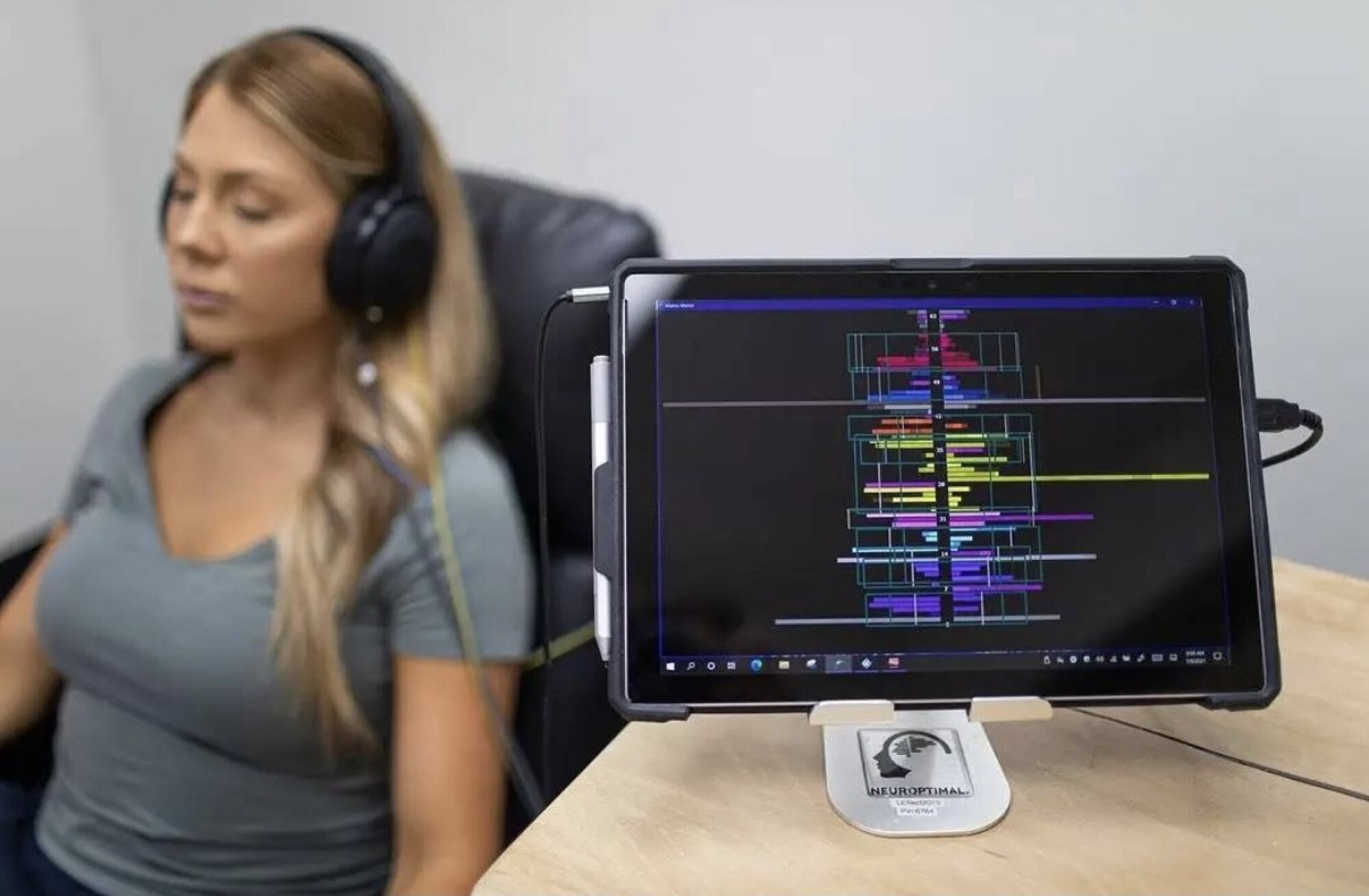
Neurofeedback takes that logic a step further. Where entrainment presents a frequency and invites the brain to follow, neurofeedback shows the brain its own activity in real time and rewards it for self-generating the target state. The feedback loop — where current brainwave patterns influence training signals that, in turn, shape future brainwave patterns — builds genuine oscillatory skill rather than simple synchronization with an external source.
The Brain Isn’t Being Led. It’s Learning
A quarter-million-dollar NIH-funded study conducted at UC San Francisco examined women aged 60 to 81 who trained their brains to restore youthful alpha brainwave patterns. The results included meaningful reductions in anxiety, depression, and elevated blood pressure, with improvements continuing to deepen at six and twelve months after training ended. The brain, given the right conditions and consistent practice, doesn’t just maintain itself. It grows. It responds. It reorganizes. Decades of quietening can be partially reversed when the right training creates a reason for the oscillatory systems to stay active.
Research on acoustic entrainment during sleep found that boosting slow-wave activity during sleep improved memory consolidation in healthy subjects. The same principle in reverse — training slow-wave capacity during waking sessions — provides the brain with practice it carries into sleep. Clients who come in describing fragmented, unrestorative sleep and who show reduced slow-wave amplitude on intake assessments often report that the quality shift in their sleep happens before they notice significant daytime changes. The brain repairs its nighttime work first.
What Clients at Sleep Recovery Experience
Many people arrive already aware that something has shifted — sleep that used to restore them no longer does, mornings that arrive without the mental clarity they remember from a decade earlier. Some come specifically because they’re watching parents or peers move through cognitive decline, and they want to know whether anything can be done therapeutically before that trajectory begins in their own brain.
What neurofeedback and entrainment offer in this context is something medication cannot: the brain exercising its own oscillatory patterns under guidance, building back the flexibility, amplitude, and coherence that quiet decline has been eroding. Sessions run 30 minutes, every other day, targeting the frequency ranges most associated with restorative sleep and calm, focused wakefulness.
What to Expect
Early responses tend to arrive quietly. Clients notice they’re staying asleep longer, that the 3 a.m. wakefulness is shortening, and that they feel slightly less braced during the day. Over weeks, the picture deepens. Sleep becomes more restorative, cognitive sharpness returns in small but noticeable ways, and the background anxiety that chronic sleep disruption produces begins to lift.
What the Xi-αNET research makes newly vivid is that these changes aren’t just symptomatic relief. When the brain’s oscillatory rhythms improve in quality, amplitude, and consistency, the underlying electrical infrastructure is being maintained — the same infrastructure the lifespan data shows beginning its decline far earlier than most people realize, and far more quietly than they expect.
The speedometer is available. The question is whether to check it before the engine starts struggling, or after. For the people who show up here in their forties and fifties, the answer is increasingly the same: they came because they didn’t want to find out the hard way.