Hypnogogic Creativity Practice: Training Your Brain’s Twilight Zone Unlocks Genius

Paul McCartney woke up one morning in 1965 with a complete melody playing in his head. He rushed to his piano and captured what became “Yesterday,” one of the most covered songs in history. Thomas Edison had a habit of deliberately dozing off while holding a metal ball, so the clatter would wake him just as insights emerged. Salvador Dalí used the same technique, calling it “slumber with a key.”
These weren’t just artistic eccentricities. They were intuitively accessing what neuroscientists now call the hypnagogic state – that twilight zone between wake and sleep where the conscious mind loosens its grip just enough for breakthrough insights to surface. And recent research published in Science Advances has quantified something remarkable: spending just 15 seconds in this state can triple your chances of solving complex problems that stumped you while fully awake.
What Happens in Your Brain at Sleep’s Edge
The hypnagogic state corresponds to what sleep researchers call N1, or non-REM sleep stage 1. This is the lightest stage of sleep, lasting only a few minutes as you transition from wakefulness into deeper sleep. Your body relaxes, your heart rate slows slightly, and your muscles begin to release their daytime tension.
But what’s happening at the brain level tells a more interesting story.
When you’re awake, your brain predominantly generates beta waves – fast, tight brain rhythms associated with active thinking, problem-solving, and focused attention. As you start to relax, these beta waves give way to alpha waves, slower frequencies around 8-12 Hz that appear when you close your eyes and let your mind drift. Alpha represents a bridge state – you’re still conscious but no longer engaged with external stimuli or analytical thinking.
As you tip into N1, alpha waves gradually decrease while theta waves (4-7 Hz) begin emerging. Theta frequencies are associated with drowsiness, meditation, and the kind of free-associative thinking that characterizes daydreaming. Autonomically, brief bursts of delta waves (1-4 Hz) start appearing, though not yet dominating the way they will in deeper sleep stages.
This particular cocktail of frequencies – declining alpha, rising theta, occasional delta – creates what researchers now recognize as a “creative sweet spot.” Your default mode network, responsible for spontaneous thinking and imagination, remains highly active. But your cognitive control network, which filters typically and evaluates ideas against practical constraints, has relaxed its grip. You can still think, but the thinking follows different rules.
The Science of the Sweet Spot
A 2021 study led by Célia Lacaux and Delphine Oudiette at the Paris Brain Institute put Edison’s technique to a rigorous test. They gave 103 participants a series of mathematical problems that appeared lengthy and tedious – but concealed a hidden rule that would allow instant solutions.
Participants worked on the problems, then took a 20-minute break. During the break, they sat in chairs holding an object in one hand, just like Edison. If they fell asleep and the object dropped, they had to report whatever thoughts or images had been in their mind. Meanwhile, EEG monitors tracked their brain activity, precisely identifying when they entered different sleep stages.
The results were striking. Test subjects who spent a minimum of 15 seconds in N1 during the break were three times more likely to discover the hidden rule afterward – 83% compared to just 30% of those who stayed awake. But the effect vanished if participants slipped into deeper sleep. The creative boost specifically required that delicate balance of being asleep enough to release conscious constraints, but not so deeply asleep that logical thinking shut down entirely.
The brain wave analysis revealed why. The participants most likely to have insights showed moderate alpha power (marking the wake-sleep transition) combined with low delta power (indicating they hadn’t gone too deep). Too much alpha meant they hadn’t really entered the hypnagogic state. Too much delta meant they’d passed through it into deeper, less creative sleep stages.
About 80% of people have experienced the hypnagogic state, and roughly a quarter of the population encounters it regularly. It shows up not just at sleep onset but also on waking and during the day, when we zone out and become drowsy. The experiences can range from vivid mental images to sounds, fleeting insights, or the sensation of falling.

Why This State Generates Breakthrough Thinking
The artistic and creative power of the hypnagogic state makes sense when you consider what creativity ultimately asks of us. Progress doesn’t come from trying harder or thinking more logically. They come from making unexpected connections between seemingly unrelated concepts – seeing patterns that rigid, analytical thinking would dismiss as irrelevant.
During normal waking consciousness, your prefrontal cortex maintains tight control over thought processes. It filters incoming information against what’s practical, probable, and directly relevant to your immediate goals. This filtering serves essential functions. Without it, you’d be overwhelmed by associations and unable to focus. But it also constrains creativity by dismissing potentially valuable connections before they fully manifest.
The hypnagogic state temporarily relaxes this filtering without completely shutting down logical ability. The default mode network, which handles autobiographical thinking, imagining future scenarios, and making distant associations, remains active and even amplified. Meanwhile, the executive control network loosens its grip enough that unusual connections can form and persist long enough to be recognized.
Psychologist Frederic Myers described this in 1881 as an “uprush” from the subliminal mind. Ideas that have been gestating unconsciously finally surface when conscious barriers drop. You’re not generating new information so much as accessing information that was already there but blocked from awareness by the usual constraints of waking thought.
This anomaly explains why people often describe creative insights as arriving fully formed, as if from beyond conscious thought. They weren’t consciously working on the problem in that moment – but their unconscious processing had continued, and the hypnagogic state provided the opening for the solution to emerge.
The Modern Problem: Most People Can’t Access This State
Here’s what the research on the hypnagogic state doesn’t address: many people struggling with stress, anxiety, or sleep problems can’t easily reach this state anymore. Their brains have become locked into chronic high-beta activation, unable to downshift into the alpha-theta frequencies that characterize healthy sleep onset.
When you’re chronically stressed, your nervous system remains in a state of hypervigilance. Even when you try to relax, your brain continues generating fast beta frequencies. You might close your eyes and lie still, but your mind races with thoughts, worries, and mental to-do lists. The transition into alpha never fully happens. And without alpha, you can’t reach the theta frequencies of early sleep.
This data is clearly visible on EEG readings. Instead of the normal progression from beta to alpha to theta to delta, chronically stressed individuals show what looks like a stuck pattern – persistent beta activity even during periods that should be restful. Their brains have essentially lost the ability to shift gears.
The consequences extend beyond missing out on creative insights. This inability to transition through normal sleep onset stages contributes to insomnia, poor sleep quality, increased anxiety, and the feeling of being mentally exhausted yet unable to rest. The brain needs regular access to these slower frequencies. When it can’t get there naturally, both cognitive and emotional function suffer.
Training Your Brain to Access the Creative State
And this is where targeted brainwave training becomes relevant. If the hypnagogic state’s creative power depends on specific frequency patterns – moderate alpha with emerging theta – then training the brain to generate these patterns on demand could restore access to this state for people whose stress has locked them out of it.
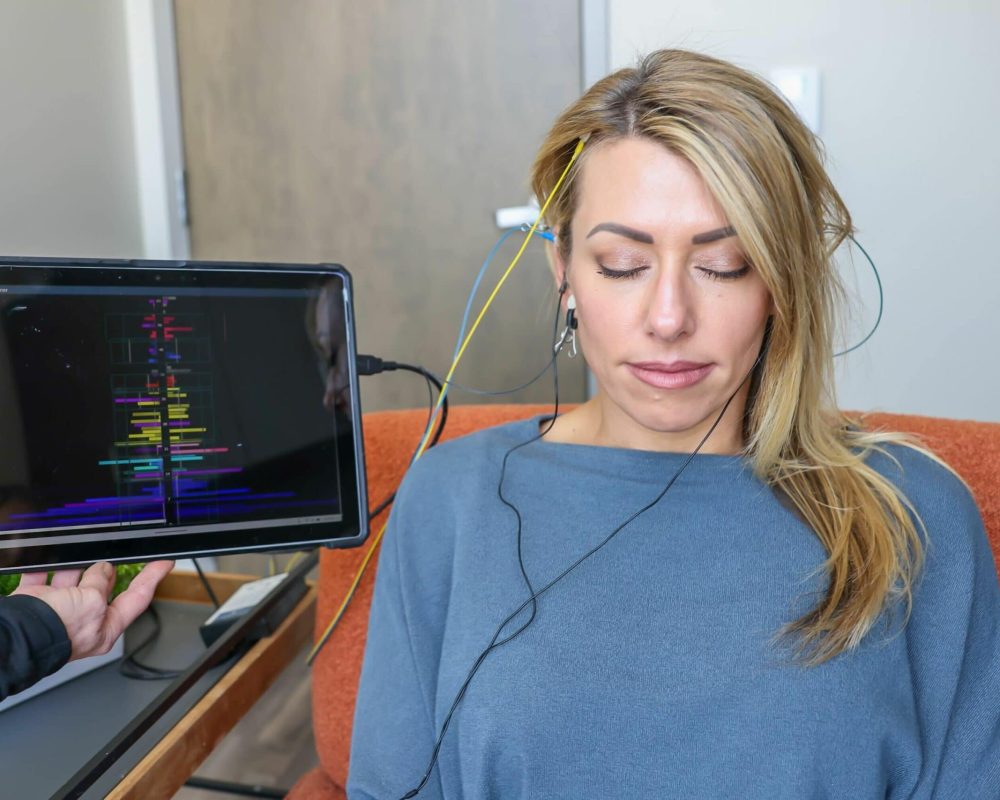
Alpha-Theta neurofeedback specifically targets the sleep onset transition. During sessions, sensors monitor your brainwave activity in real time. When your brain produces the desired pattern – increasing alpha and theta while reducing beta – you receive immediate feedback through audio tones or visual displays. The brain quickly learns to generate these patterns more readily.
The protocol doesn’t just teach relaxation in some vague sense. It’s training a particular neurological skill: the ability to downshift from beta activation into alpha-theta frequencies while maintaining enough awareness to capture insights that emerge. You’re learning to access and sustain the hypnagogic state deliberately rather than only catching it accidentally at sleep onset.
Typical sessions last 30 minutes and occur every other day. The consistency matters more than intensity – the brain needs repeated exposure to these patterns to reestablish them as accessible states. Most people begin noticing changes within 2-3 weeks. They find it easier to fall asleep. Their minds feel less perpetually wired. Some report having more creative insights or finding solutions to problems they had felt stuck on.
But beyond the subjective reports, EEG measurements show the actual changes in brain function. The stuck high-beta pattern begins breaking up. Alpha production increases. The brain regains its flexibility to move fluidly between different frequency states rather than remaining locked in stress-driven activation.
This isn’t about forcing creativity or manufacturing insights. It’s about removing the neurological barriers that prevent the brain from accessing states it naturally should be able to reach. When someone with chronic stress starts showing healthy alpha-theta patterns again, they’re not learning something artificial – they’re recovering a capacity that stress had disrupted.
Brainwave Entrainment as an Alternative Approach
While neurofeedback uses operant conditioning to help the brain learn new patterns, brainwave entrainment takes a different approach. It uses external auditory or visual stimuli that pulse at specific frequencies to guide the brain toward desired states via the frequency-following response.
When you listen to audio pulses at 7 Hz (theta frequency), your brain tends to synchronize with that external rhythm. It happens automatically, through the exact neurological mechanisms that make us tap our feet to music with a strong beat. Over repeated sessions, the brain becomes more familiar with generating these frequencies and can access them more easily without the external cue.
To access the hypnagogic state, protocols typically use alpha-theta entrainment, starting with alpha frequencies to ease the transition from beta, then gradually decreasing to theta as the session progresses. The person remains awake throughout but experiences the relaxed, free-associative mental state characteristic of sleep onset.
Combined approaches using both neurofeedback and entrainment can be particularly effective. Neurofeedback builds the brain’s capacity to self-regulate and generate desired patterns. Entrainment provides external support during the learning process and helps people experience what these target states feel like subjectively. Over time, the brain internalizes these patterns and can access them independently.
Practical Applications Beyond Creativity
The practical applications of alpha-theta training extend well beyond creativity. The same neurological flexibility that enables insights also supports emotional regulation, stress resilience, and healthy sleep architecture.
People learning to access alpha-theta states typically experience quieter racing thoughts in the evening, decreased anxiety through improved ability to shift out of hypervigilant states, less volatile emotional reactions, and substantially improved sleep quality throughout the night. Once the brain relearns healthy frequency transitions, it maintains them more consistently through regular sleep cycles.
For those whose sleep architecture is impaired by chronic stress, alpha-theta training addresses the root dysregulation rather than just managing symptoms. The goal is restoring the brain’s natural ability to transition fluidly between activation and rest.
Capturing the Insights That Emerge
One practical challenge with intentionally accessing the hypnagogic state is capturing the insights that emerge before they slip away. Edison and Dalí solved this by using objects that would wake them with noise. More modern approaches might involve:
Keeping recording equipment immediately accessible. Your phone with voice recording ready, or a notepad right beside where you’ll be sitting or lying down.
Setting a gentle alarm for 15-20 minutes into a rest period. This timing catches you during the target window without relying on dropped objects.
Practicing recalling and recording insights immediately upon waking naturally. The more you rehearse this, the more automatic it becomes.
Working with a partner who can ask what you’re experiencing at strategic moments during a practice session.
The key is finding the balance between enough alertness to capture insights and enough relaxation actually to access the state in the first place. Disciplined training helps – as your brain becomes more skilled at generating and maintaining alpha-theta patterns, you can hold them consciously rather than only experiencing them in fleeting moments at sleep’s edge.
Meditation and the Hypnagogic Bridge
Research consistently shows strong associations between meditation practice and creativity. It makes sense given that meditation cultivates many of the same neurological patterns as the hypnagogic state. Experienced meditators show increased alpha and theta activity, reduced dominance of the default mode network, and greater cognitive flexibility.
But meditation doesn’t precisely replicate the hypnagogic state. Most meditation practices maintain more alertness and conscious control than you have in N1 sleep. Some advanced practitioners can enter states resembling sleep onset while remaining aware, what Tibetan traditions call “yoga nidra” or “conscious sleep.” But for most people, meditation provides a bridge toward the hypnagogic state rather than fully accessing it.
It is one advantage of targeted brainwave training. It can help people reach specific frequency patterns they struggle to access through meditation alone. Someone whose brain gets stuck in beta activation might meditate diligently but never reach the deep alpha-theta states that characterize both advanced meditation and sleep onset. Neurofeedback or entrainment provides scaffolding to help them learn these states experientially.
Once established, these states become more accessible during meditation practice. The brain generalizes the learning – what it masters during structured training sessions transfers to other contexts.

The Bigger Picture: Valuing Rest as Productive
Perhaps the most critical insight from research on the hypnagogic state isn’t just that it boosts creativity, but that it challenges our cultural assumptions about productivity. We’ve created a society that valorizes constant activity and treats rest as wasted time. The idea that lying down with your eyes closed could be your most productive hour contradicts everything we’ve learned about getting ahead.
But the evidence increasingly suggests that breakthrough thinking requires periods of disengagement from active problem-solving. The conscious mind needs to step back so the unconscious can do its work. This process happens during sleep, meditation, mind-wandering, and that peculiar twilight zone of half-sleep where logic and imagination meet.
For anyone working in creative fields, dealing with complex problems, or simply trying to maintain cognitive flexibility in a demanding world, learning to access and utilize the hypnagogic state could be among the most valuable skills to cultivate. Not because it provides a shortcut around hard work, but because it complements focused effort by enabling different kinds of mental processing.
The research on sleep onset and creativity isn’t permitting us to be lazy. It’s revealing that the brain performs certain essential functions only when we stop trying so hard. Understanding this – and having practical tools to facilitate it through brainwave training – may be one key to sustaining both creative vitality and mental health in modern life.
Study Citation: Lacaux C, Andrillon T, Bastoul C, Idir Y, Fonteix-Galet A, Arnulf I, Oudiette D. Sleep onset is a creative sweet spot. Science Advances. 2021;7(50):eabj5866. doi:10.1126/sciadv.abj5866