Dead by Every Measurement: Then She Described the Bone Saw

Pam Reynolds was a singer-songwriter from Atlanta. In 1991, she was 35 years old, and a routine dizzy spell turned out to be a giant aneurysm on her brainstem. The neurosurgeon who agreed to operate told her plainly that the only way to reach it was to kill her first, essentially.
The procedure was called Operation Standstill. Her body temperature would be dropped to 60 degrees. Her heart would be stopped. Every drop of blood would be drained from her head. Her brain, by every clinical measure, would go offline completely — no electrical activity, no blood flow, nothing. Her surgeon, Robert Spetzler, at the Barrow Neurological Institute in Phoenix, monitored her continuously. Her EEG went flat. Her brainstem evoked potentials — the last measurable whisper of neural function — registered zero. Twenty doctors and nurses worked in the room around her clinically dead body.
She later described what she saw.
She described a bone saw that looked like an electric toothbrush, with interchangeable blades stored in a case resembling a socket wrench. She described a conversation between a female cardiac surgeon and Spetzler about her femoral arteries being too small, and a male voice saying to try the other side. She described the Eagles’ song “Hotel California” playing as her heart was being restarted. She identified the pitch of the bone saw as a natural D. She was a musician — she would know.
Spetzler reviewed her account afterward. Cardiologist Michael Sabom cross-referenced her description against surgical records she had never seen. Every verifiable detail checked out. Her eyes had been taped shut. Small speakers in her ear canals were firing loud clicks continuously to monitor brainstem function. Her brain was not functioning. Spetzler, who is not a man given to dramatic statements, said on record: “If you would examine that patient from a clinical perspective during that hour, that patient by all definitions would be dead.”
So how did she know about the bone saw?
Neuroscience Has a Good Answer. And a Problem.
Researchers have worked hard on this question and made genuine progress. Dr. Charlotte Martial of the University of Liège has spent years mapping the neuroscience of near-death experiences, and her 2025 model, published in Nature Reviews Neurology, is the most comprehensive attempt yet to explain them through known biology. When cardiac arrest cuts off blood flow to the brain, a cascade unfolds — oxygen levels drop, carbon dioxide levels spike, energy stores collapse, and neurotransmitter systems flood simultaneously. Serotonin, dopamine, glutamate, and noradrenaline — all are released at once. Researchers at the U of M in Ann Arbor, MI documented bursts of gamma wave activity in dying patients, the brain’s fastest oscillations, concentrated in the region most associated with conscious awareness. The death-throes model says that final electrical surge produces the tunnel, the light, the overwhelming sense of peace and meaning. The brain is generating one last vivid internal world before the lights go out permanently.
It’s a credible model. The overlap between NDE accounts and psychedelic experiences, particularly ketamine and DMT, supports it further. The same neurochemical chaos that floods the dying brain can be partially recreated in a laboratory, and the experiences people report share striking features with NDE accounts. Structured. Emotionally overwhelming. Feeling more real than ordinary life.
But here’s where the timeline goes sideways. EEG activity goes flat within about 15 seconds of cardiac arrest. In four major prospective studies involving 562 cardiac arrest survivors, between 10 and 20 percent reported vividly structured experiences of conscious awareness during clinical death, and not one of those patients was resuscitated within 20 seconds. The experiences aren’t happening in the brief window before silence. They’re happening during the silence. Studies specifically designed to detect high-frequency brain activity at the actual moment of circulatory arrest haven’t found it. The gamma surge hypothesis mostly shows activity occurring before cardiac arrest, or under conditions too chaotic and low-coherent to plausibly generate the organized, detailed, accurate perception Pam Reynolds reported.
Systematic research has now cataloged more than a hundred veridical NDE cases. People reporting accurate details of their resuscitation, verified independently by medical staff who were present. A formal measurement scale for evaluating the evidential strength of these perceptions was published in Frontiers in Psychology in 2025, indicating that the scientific community now takes them seriously. You don’t build measurement instruments around phenomena you’ve already explained away.
The honest position, held by rigorous researchers, including Bruce Greyson at the University of Virginia, who has studied this longer than almost anyone — is that the neurobiological model accounts for the content and structure of NDEs very well, and fails to account for accurate environmental perception during confirmed brain silence. Both things are true at once, and science hasn’t resolved the tension between them.

Every Night, Your Brain Touches the Same Doorway
Here’s what makes this personally relevant to anyone reading this before they’ve had a cardiac arrest — which, fingers crossed, is most of you.
The brain passes through a state every single night that shares more with what NDE researchers are documenting than most people realize. It happens in those few minutes between wakefulness and sleep, when alpha waves are giving way to theta, and the brain’s ordinary filtering mechanisms start to loosen their grip. The hypnagogic gateway — named from the Greek words for sleep and conductor. Leading toward sleep. Most people fall through it unconsciously in under a minute. Some barely notice it at all.
But look at what happens there. EEG recordings show the characteristic alpha-to-theta shift; spontaneous vivid imagery arises; the sensation of floating appears; sounds sharpen; presences are felt. The prefrontal cortex — the brain’s editor, the part that keeps experience orderly and logical — begins standing down. What comes up in that space is often strange, emotionally resonant, and carries a quality that ordinary waking thought doesn’t. Artists have deliberately cultivated this state for centuries. Edison used to fall asleep holding ball bearings over a plate — when they dropped and woke him, he’d have whatever solution his ordinary mind had been unable to reach. Dalí did the same thing with a key. The hypnagogic state reliably produces what structured analytical thinking cannot.
The alpha-theta border lies around 7-8 Hz — the crossover zone where neither state dominates. That’s precisely where the richest hypnagogic imagery occurs, where the brain’s usual account of reality softens enough for something else to surface. Ancient contemplative traditions — Tibetan Buddhist dream yoga, Sufi practice, shamanic traditions across dozens of cultures — treated this threshold as a legitimate technology for accessing dimensions of experience that ordinary waking consciousness keeps locked out. Not as a metaphor. As practice.
What We See at Sleep Recovery
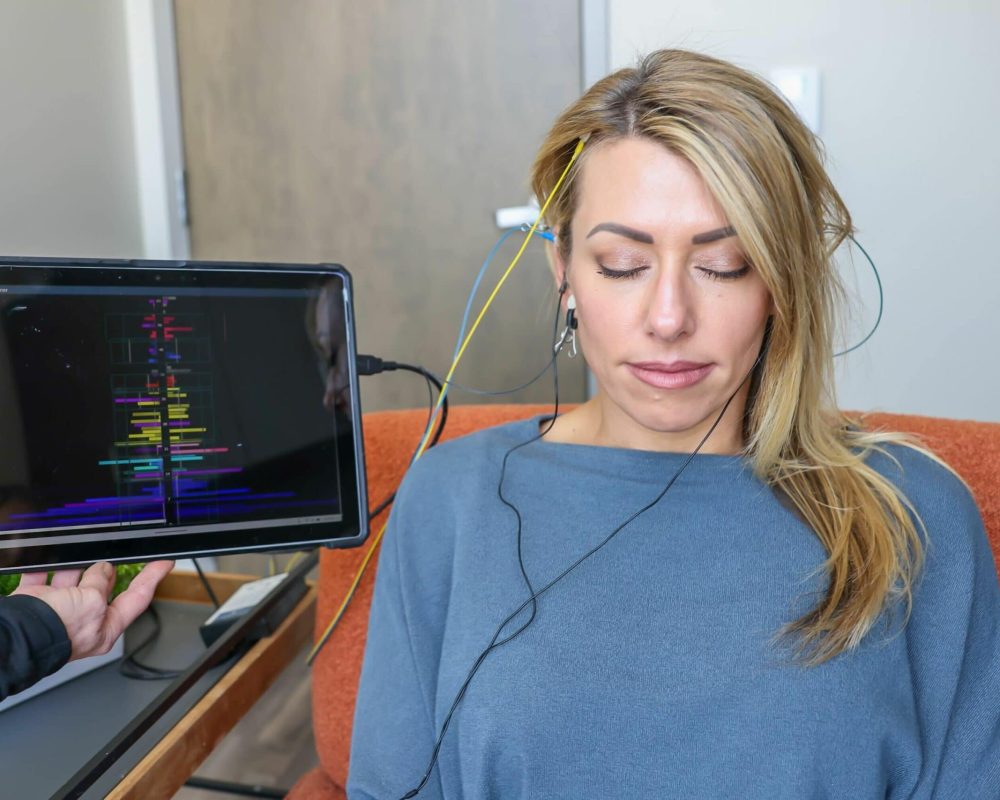
Alpha-theta neurofeedback works in exactly this zone. The goal is to guide your brain into that crossover frequency and help it stay there long enough to actually experience what lives in that territory, rather than collapsing through it into sleep before anything registers.
When rest into this, and your brain finds that threshold, you’ll often know it. A quality of space opens up that doesn’t resemble ordinary relaxation. Imagery arises — not the verbal, logical kind your waking mind produces, but something more associative, more visual, carrying emotional weight that seems disproportionate to whatever appeared. Occasionally, clients describe a profound peace that nothing in their ordinary life has quite matched. A sense that some layer of themselves they don’t usually have access to has briefly become available.
These aren’t pathological experiences. They’re not something going wrong. They’re what happens when the brain learns to move through the hypnagogic gateway with enough stability to actually be present there, rather than stumbling through it unconscious every night on the way to sleep.
The connection to NDE research isn’t metaphorical. NDE experiencers consistently report lasting changes no other life experience produces at the same depth — reduced fear of death, increased compassion, fundamental shifts in what matters. Clients who’ve had genuine alpha-theta crossover experiences describe something structurally quieter but recognizably similar — a reorganization, a loosening, a sense that the brain’s ordinary story about itself isn’t the complete picture.
What Pam Reynolds encountered — whatever it actually was — happened in a context of total physiological extremity. The brain, stripped of every normal operating condition, apparently accessed something. Whether that something is consciousness temporarily freed from its neural substrate, or a property of the alpha-theta transition the dying brain passes through on its way out, is a question the data hasn’t closed.
What’s clear is that the threshold is real. The doorway opens every night. Most people never notice it. Some, with the right training, learn to stand in it long enough to find out what’s on the other side.