The Insomnia-Anxiety Cycle: How Sleeplessness and Worry Feed Both

Research from Saudi Arabia just proved that anxiety and insomnia don’t just make you tired, they quietly dismantle one of your body’s most important defenses. Natural killer cells, the immune system’s rapid-response team drop significantly in people experiencing both conditions. The more severe your anxiety, the fewer NK cells you have protecting you.
Dr. Renad Alhamawi and her team at Taibah University studied 60 young women and found something unsettling. Students with moderate to severe anxiety showed a notably reduced percentage of circulating NK cells compared to those without symptoms. Among students with insomnia, higher anxiety scores correlated with even lower NK cell counts. Your body’s ability to fight off infections, destroy abnormal cells, and prevent tumor growth weakens as the anxiety-insomnia cycle tightens its grip.
But immune dysfunction represents just one piece of a much darker picture.
The Bidirectional Trap
Most people assume anxiety causes insomnia. You can’t sleep because you’re worried. That’s obviously true. But decades of research reveal something more disturbing – the relationship runs both directions. Insomnia doesn’t just result from anxiety. Insomnia actively creates and worsens anxiety.
A 2013 systematic review examined 9 longitudinal studies that tracked thousands of people over time. Four studies supported the bidirectional theory outright. One found that anxiety predicted insomnia AND insomnia predicted depression, creating a three-way feedback loop. The evidence keeps mounting, recent analyses show that among insomnia patients, 87.1% have depression and 88.0% have anxiety symptoms.
These aren’t just correlated conditions. They’re mutually reinforcing states that trap people in escalating cycles of dysfunction.
Research published in Sleep Medicine demonstrates how this works neurologically. Anxiety disrupts sleep through heightened cognitive and physiological arousal. Your mind races. Your heart pounds. Your muscles stay tense. Sleep becomes impossible. Then the sleep loss itself impairs emotional regulation, increases amygdala reactivity, and reduces prefrontal cortical control. You become more vulnerable to anxiety the next day.
The cycle repeats. Each rotation makes both conditions worse.

How Exhaustion Becomes Fuel
Here’s where your body’s survival mechanisms turn against you. After a sleepless night, you wake up exhausted. Your brain fog makes simple tasks feel impossible. You can’t concentrate. You can’t make decisions. Your body recognizes this state as dangerous – you’re functionally impaired, vulnerable, unable to respond effectively to threats.
So your autonomic nervous system activates a compensatory response. The sympathetic nervous system – your fight-or-flight system – floods your body with stress hormones. Adrenaline and cortisol surge. Your heart rate increases. Blood pressure rises. You feel jittery, on edge, hypervigilant.
This sympathetic activation isn’t accidental. It’s your CNS using anxiety as a propellant to power you through the day despite exhaustion. The anxiety gives you artificial energy. It keeps you moving when your body desperately needs rest.
Studies on the autonomic nervous system show that chronic stress keeps the sympathetic system continuously activated, without the normal counteraction of the parasympathetic system. The “rest and digest” system that should calm you down stops functioning properly. You remain locked in constant threat response.
This situation creates a terrible bargain. Your brain sacrificed last nights sleep to function today. The anxiety that keeps you awake also keeps you functional the next morning. Your body learns that anxiety serves a purpose – it compensates for sleep deprivation. The pattern reinforces itself.
The Downward Spiral Accelerates
But anxiety makes terrible fuel. Each use depletes you further. Research demonstrates that when the sympathetic nervous system stays activated for days or weeks, it triggers inflammatory responses throughout your body. Pro-inflammatory cytokines increase. The immune system becomes dysregulated. Physical health deteriorates alongside mental function.
And anxiety actively sabotages the sleep you desperately need. Studies tracking sleep and anxiety show that the excessive cognitive arousal characteristic of anxiety interferes with both sleep onset and maintenance. You can’t fall asleep because your mind won’t stop. You can’t stay asleep because your nervous system remains on high alert.
The sleep you do get becomes progressively worse. Network analysis of insomnia patients reveals that sleep quality, sleep duration, and sleep efficiency all decline as anxiety severity increases. You might spend eight hours in bed but get only four hours of actual restorative sleep.
Each night, your sleep debt grows. Each day, your body requires more anxiety-driven compensatory activation to function. The amount of stress hormones needed to power through exhaustion keeps rising. Eventually, you’re running on nothing but adrenaline and cortisol while accumulating massive sleep deprivation.
When the Mind Starts Breaking
After 24 hours without sleep, perceptual distortions begin. Life problems can appear larger than they actually are. Spatial relationships seem off. Colors become more vivid or washed out. You know something feels wrong, but you can’t quite identify what.
By 48 hours, simple visual hallucinations emerge. Flashes of light. Shadows moving in your peripheral vision. Patterns that aren’t actually there. Most people still recognize these as false perceptions at this stage.
After 72 hours without sleep, complex hallucinations and delusions develop. You see detailed imagery that isn’t reality. Your body feels tactile sensations with no physical cause. And most alarming, you start believing these perceptions are real.
The progression follows a consistent pattern. Visual distortions appear first, followed by somatosensory changes, then auditory hallucinations. By the third day of total sleep deprivation, all three sensory modalities show dysfunction. Thought becomes disorganized. Delusions form. The clinical picture resembles acute psychosis or toxic delirium.
Research examining 760 participants across 21 studies confirms that sleep deprivation produces bonified psychotic symptoms in healthy individuals with previous no psychiatric history. The symptoms aren’t subtle. After five days without sleep, people become indistinguishable from patients experiencing acute psychotic breaks.
The mechanism involves dopamine dysregulation and cholinergic depletion. Sleep deprivation creates a maladaptive hyperdopaminergic state. The brain floods with dopamine to maintain wakefulness. This excess dopamine triggers the same neural pathways involved in schizophrenia. Paranoia emerges. Hallucinations intensify. Reality testing fails.
Meanwhile, acetylcholine, crucial for both sleep regulation and sensory processing, becomes depleted. Without adequate acetylcholine, your brain loses its ability to distinguish internal mental activity from external sensory input. Dreams bleed into waking consciousness. Thoughts become tangible. The boundary between internal and external reality dissolves.
For most people, sleeping normally for one or two nights resolves the acute psychotic symptoms. But not everyone recovers completely. Some individuals develop persistent symptoms even after sleep resumes. The factors determining who experiences lasting damage remain unclear.
The Clinical Reality
At Sleep Recovery, we’ve worked with clients at every stage of this progression for over 17 years. Some arrive after a few weeks of poor sleep with mild anxiety. Others come to us completely debilitated – months of chronic insomnia feeding severe anxiety that makes sleep impossible.
The pattern holds consistently regardless of initial severity. Insomnia creates exhaustion. The autonomic nervous system compensates with anxiety-driven activation. That anxiety further disrupts sleep. Sleep quality declines. Anxiety intensifies. The cycle accelerates until something breaks – either the person gets intervention, or their mental state deteriorates into an acute crisis.
Traditional approaches often target only one side of the equation. Prescribe sleep medication without addressing the anxiety. Or treat the anxiety while ignoring the sleep dysfunction. Both approaches fail because they don’t account for the problem’s bidirectional nature.
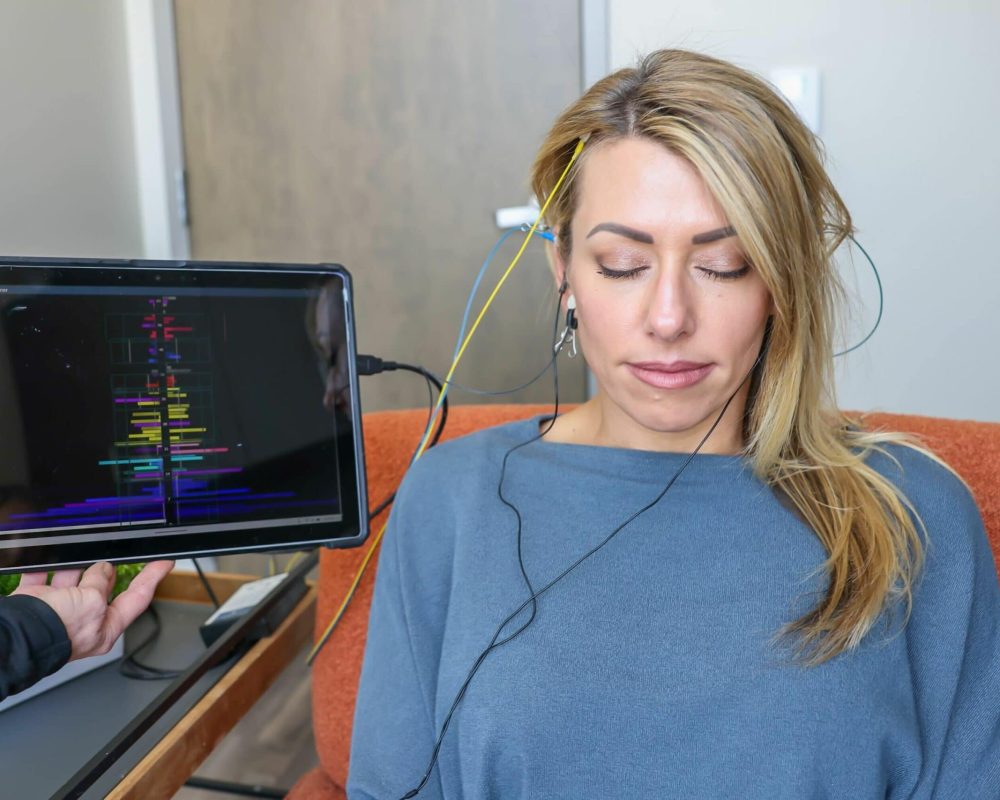
Alpha-theta neurofeedback addresses both simultaneously. Clients learn to regulate the exact brain patterns that maintain both insomnia and anxiety. The technique doesn’t rely on chemical intervention. It teaches direct regulation of the nervous system itself.
Most clients begin seeing improvements within 10-12 sessions. Sleep onset becomes easier. Sleep quality improves. The anxiety that was powering them through exhausted days gradually diminishes as actual rest replaces compensatory stress activation. The vicious cycle reverses direction.
But the severity matters. Someone experiencing mild insomnia and moderate anxiety responds much faster than someone who’s been trapped in this cycle for years. Chronic, severe cases require a more nuanced approach. People moving into psychotic decompensation from long-term sleep deprivation would need immediate medical stabilization before neurofeedback becomes appropriate.
The research is detailed – treating sleep disturbances reduces anxiety symptoms, and treating anxiety improves sleep quality. You can’t successfully address one while ignoring the other. The conditions exist in a bidirectional relationship. Any effective intervention must target both.
Most people don’t recognize they’re caught in this trap until it’s already tightened them up in knots. The early stages feel manageable. You have some difficulty sleeping. You feel more anxious than usual. Nothing alarming yet.
But certain patterns signal that you’re entering dangerous territory:
Your sleep gets progressively worse over weeks rather than improving. You need increasing amounts of caffeine to function during the day. You feel wired and tired simultaneously. Small stressors trigger disproportionate anxiety and/or rage. You start noticing subtle perceptual oddities, colors seeming off, sounds seeming distant, spatial distances feel strange.
These signs indicate that your nervous system’s compensatory mechanisms are failing. The anxiety-fueled activation that’s been powering you through exhaustion has reached its limits. Your brain can’t maintain normal function under this level of sustained stress and sleep deprivation.
At this stage, immediate intervention becomes critical. Waiting for things to improve naturally rarely works. The cycle has gained too much momentum. Without external disruption, it continues to escalate toward a crisis.
Breaking Free
The insomnia-anxiety trap is real. It’s neurologically based. It’s bidirectional. And it can progress to genuinely dangerous mental states if left untreated.
But it’s also reversible. Your nervous system has a remarkable capacity for regulation once the cycle gets interrupted. Sleep improves when anxiety decreases. Anxiety decreases when sleep quality improves. Breaking the pattern in either direction initiates recovery.
The key is recognizing the trap early and addressing both conditions simultaneously rather than treating them as separate problems. Your insomnia and your anxiety aren’t two different issues. There are two symptoms of a dysregulated system feeding on itself.
At Sleep Recovery, we’ve spent 17 years helping people escape this trap using neurofeedback and Buddhist-based CBTi approaches that target both the underlying nervous system dysfunction, and the mental though-formations that reenforces the entire dynamic.
Your brain wants to sleep normally. The trap isn’t your natural state. It’s a maladaptive pattern that developed over time as one problem amplified another. Once interrupted, healthier patterns can re-establish themselves remarkably quickly.
The question isn’t whether escape is possible. The question is whether you’ll recognize the warning signs before the spiral tightens into something much harder to reverse.
For more info on Sleep Recovery’s programs, please visit: https://sleeprecovery.net Or call: 800-927-2339